Solemnity of the Immaculate Conception Gospel Reflection for Catechists – December 8, 2025
“Behold, I am the handmaid of the Lord. May it be done to me according to your word.”

You can find today’s Mass readings here.
The Gospel
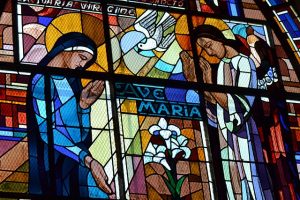
The angel Gabriel was sent from God
to a town of Galilee called Nazareth,
to a virgin betrothed to a man named Joseph,
of the house of David,
and the virgin’s name was Mary.
And coming to her, he said,
“Hail, full of grace! The Lord is with you.”
But she was greatly troubled at what was said
and pondered what sort of greeting this might be.
Then the angel said to her,
“Do not be afraid, Mary,
for you have found favor with God.
Behold, you will conceive in your womb and bear a son,
and you shall name him Jesus.
He will be great and will be called Son of the Most High,
and the Lord God will give him the throne of David his father,
and he will rule over the house of Jacob forever,
and of his Kingdom there will be no end.”
But Mary said to the angel,
“How can this be,
since I have no relations with a man?”
And the angel said to her in reply,
“The Holy Spirit will come upon you,
and the power of the Most High will overshadow you.
Therefore the child to be born
will be called holy, the Son of God.
And behold, Elizabeth, your relative,
has also conceived a son in her old age,
and this is the sixth month for her who was called barren;
for nothing will be impossible for God.”
Mary said, “Behold, I am the handmaid of the Lord.
May it be done to me according to your word.”
Then the angel departed from her.
The Core Message
Be sure to read and reflect on all of the readings for today! I love how the first reading is about Adam and Eve, so that we can more fully embrace and appreciate the Gospel on the New Eve (Mary!). Mary was conceived without original sin, and she always did the will of God perfectly and completely.
“Behold, I am the handmaid of the Lord. May it be done to me according to your word.”*
Connection to Aquinas: ST III, Q.27, a.4–5
Many sections of the Summa are dedicated to the Blessed Virgin Mary. However, the dogma of Our Blessed Mother’s Immaculate Conception was not defined until 1854 by Pope Pius IX (Aquinas lived from 1225-1274). Interestingly, Aquinas did prepare for and provide a foundation for the dogma of the Immaculate Conception! He knew she was cleansed of original sin at some point in the womb, but just didn’t pinpoint exactly when (ST III, Q.27, a.2), and he laid crucial groundwork to lead to discussions and confirmation that Mary was conceived “full of grace.” (ST III, Q.27, a.5). He did determine that she was sanctified before birth, but he does not conclude exactly when she was freed from original sin.
The Summa is an absolutely fantastic reference and resource that paved the way for our modern catechisms (in fact, it is quoted abundantly in the Catechism of the Catholic Church, so we should look to it for guidance, knowledge, understanding and wisdom), but we know that Aquinas was not infallible. He was a human too, after all! (Albeit an extremely wise and holy human!) Thus, we should study all of the writings, Sacred Scripture, catechism, and traditions that Holy Mother Church holds out to us. Please see CCC 490-493 for the full explanation of the Immaculate Conception.
So, what did Aquinas write on the Mary’s conception? First, in ST III, Q.27, a.5, he concludes that she was sanctified and freed from original sin in the womb. Aquinas states that:
“The Church celebrates the feast of our Lady’s Nativity. Now the Church does not celebrate feasts except of those who are holy. Therefore even in her birth the Blessed Virgin was holy. Therefore she was sanctified in the womb.” (emphasis added)
He then points out that there is no mention of Our Lady’s cleansing from original sin in Sacred Scripture. BUT, he goes on to say that St. Augustine explains that Mary was, in fact, assumed into heaven, and this truth is nowhere in Sacred Scripture either. Therefore, the absence of the Immaculate Conception in Sacred Scripture does not mean that it didn’t happen. Therefore, Aquinas concludes that it is perfectly sound and reasonable to believe that Mary was conceived without original sin, even though it doesn’t explicitly state this in Sacred Scripture.
Aquinas then refers to scripture to affirm the fact that she must have been sanctified in the womb:
“For it is reasonable to believe that she, who brought forth “the Only-Begotten of the Father full of grace and truth,” received greater privileges of grace than all others: hence we read (Luke 1:28) that the angel addressed her in the words: “Hail full of grace!”
The clarification that came later was exactly when Mary was cleansed of original sin. We celebrate the Immaculate Conception today wherein we believe that Mary was conceived without original sin. Thus, Mary was free from original sin from the moment of her conception.
CCC 491 states:
Through the centuries the Church has become ever more aware that Mary, “full of grace” through God,134 was redeemed from the moment of her conception. That is what the dogma of the Immaculate Conception confesses, as Pope Pius IX proclaimed in 1854: “The most Blessed Virgin Mary was, from the first moment of her conception, by a singular grace and privilege of almighty God and by virtue of the merits of Jesus Christ, Savior of the human race, preserved immune from all stain of original sin.135”
A Reflection for Catechists
Mary always said “yes” to God in the small and big things! How are we working on hearing God’s voice and calls in the big and the small? How can we continue to say “yes” to Him even when it is difficult?
A Prayer for Catechists
Lord, help us to say “yes” like Your Blessed Mother in the big and small things. Please give us fortitude like Mary to do Your will in all things. Amen.
This post originally appeared on Alex Resch’s Substack on December 8, 2025. Alex will be publishing Gospel reflections for catechists throughout the season of Advent.
 Here we are in Advent, in the month of December which is dedicated to the Divine Infancy and the Immaculate Conception. And so, we are reminded that despite the busy-ness around us, we are called to keep vigil with the sacred. May this Advent, which is meant to be, in some ways, a kind of mini-Lent: a time of waiting and preparation (anticipating Christmas joy)… be our holiest yet.

 2)Mary is Patroness of the United States
 Over time, your children will get used to the routine and the wiggling and complaining will decrease over time. It is acceptable to allow small children to play with a quiet toy or book. They are still listening and absorbing everything. A child who has reached the age of reason can be expected to kneel or sit reverently and follow along with his or her own rosary beads, book, or other aid (more on these below). It is important for the older children to be a good example to the younger children.

 OSV also has these beautiful Rosary books that are appropriate for ages 3 and up


 October is dedicated to Our Lady of the Rosary. The feast of Our Lady of the Rosary falls on October 7th. Ultimately, the rosary brings us closer to Our Blessed Mother. Our Blessed Mother brings us closer to her Son! Having a relationship with Jesus and His Blessed Mother bring adults and kids peace and comfort.

 2. Play Battleship – Battle of Lepanto Style!
 5. Take a Rosary walk


